
How to Build a Sports City That Works
Around the world, billions are being invested into sports infrastructures - yet many of them will never work as intended. From large-scale event venues to elite academies and mixed-use communities, billions are being invested into projects aiming to combine sport, lifestyle, and real estate.
Yet, despite the ambition, many of these developments struggle to deliver long-term value.
They are often built around moments - tournaments, events, or short-term visibility - rather than systems that generate sustainable activity, stable revenues, and real community impact. The paradox is that the more a project depends on events, the less stable it becomes.
The result is a familiar pattern: world-class facilities, underutilized assets, and financial models that rely heavily on external funding rather than internal resilience.
To build a sports city that truly works - both financially and socially - requires a fundamentally different approach.
A Sports Infrastructure Alone Is Not a Business Model
At its core, sport is powerful - culturally, emotionally, and socially. But as a standalone business, it is often unpredictable. Revenue streams tied to events, ticketing, sponsorships, or elite performance are inherently volatile. This makes it extremely difficult to build a stable financial foundation around sport alone. A successful sports city cannot rely on peaks. It must be built on consistency.
From Event-Driven to System-Driven
The most effective sports developments are not designed as destinations - they are designed as ecosystems.
Instead of asking:
How do we attract events?
They ask:
How do we create daily activity?
How do we ensure continuous usage of infrastructure?
How do we build predictable, recurring revenue streams?
This shift - from event-driven thinking to system-driven design - is where most projects either succeed or fail.

Education as the Financial Backbone
One of the most overlooked, yet most powerful, drivers in a sports city is structured education. Not as an add-on - but as the core.
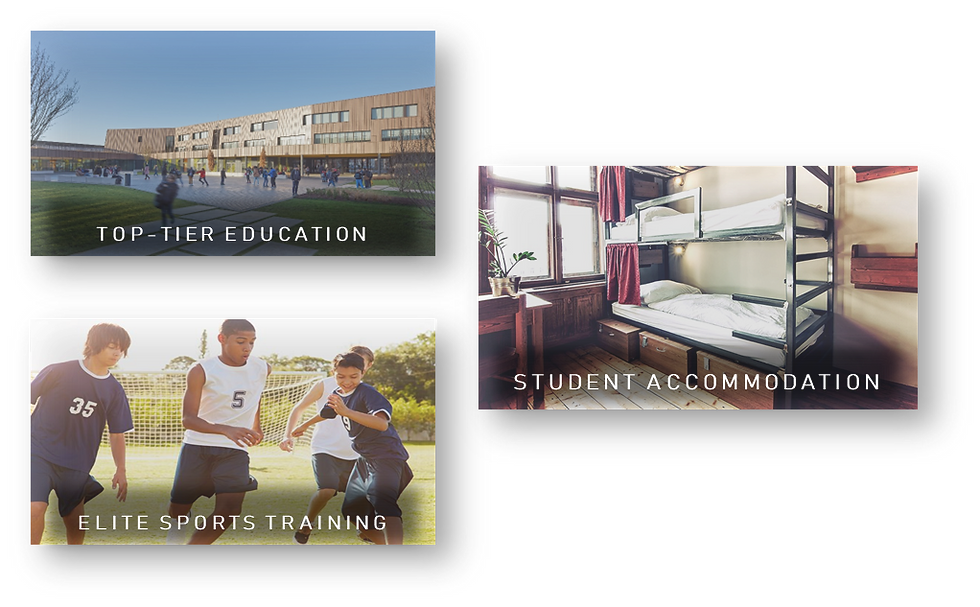
A well-designed sports city integrates:
Sports academies
Boarding schools
Education programs linked to athletic development
These are not just complementary elements - they are the engine.
Why, because education creates:
Recurring revenue (tuition-based, predictable income)
Daily utilization (facilities used every day, not occasionally)
Long-term residency (students, families, and staff embedded in the ecosystem)
Global demand (parents consistently invest in structured development pathways)
As seen in broader education markets, institutional investors increasingly value school platforms precisely because they offer stable and scalable cash flows . In a sports city context, this stability becomes transformational.
A Circular Ecosystem
A sports city that works is not linear - it is circular - and when designed correctly, demand is not imported - it is generated internally:
Education feeds sport.
Sport feeds community.
Community feeds real estate.
Real estate feeds lifestyle and services.
And all of it feeds back into education.
This creates a self-reinforcing system where:
Facilities are continuously activated
Revenue streams are diversified but interconnected
Demand is generated internally, not only externally
Instead of building isolated assets, you build interdependent value.
Proximity Drives Performance
Urban design plays a critical role in making the model work. When everything is within walking distance - training facilities, schools, accommodation, and working & social spaces - something important happens:
Friction is reduced
Time is optimized
Interaction increases
In well-designed environments, all key functions are typically accessible within minutes, enabling efficient daily movement and maximizing usage across the entire ecosystem .
This is not just about convenience - it directly impacts both performance and commercial efficiency.
Community Over Infrastructure
Many developments focus heavily on infrastructure - stadiums, arenas, and iconic architecture. But infrastructure alone does not create value. People do.
A successful sports city prioritizes:
Athletes in development, not only professionals
Students, not just spectators
Families, not just visitors
When people live, learn, work, and train in the same ecosystem, engagement becomes natural and continuous. That is where true cultural and social impact is built.
This creates a living environment - not a project.

The Financial Outcome - Stability + Upside
When structured correctly, the model delivers a rare combination:
1. Stability
Predictable revenue from education and residential components
High utilization of facilities
Reduced dependency on external events
2. Upside
Elite sports pathways and performance visibility
Sponsorship and brand partnerships
Real estate appreciation driven by community demand
This dual dynamic - stable base with performance upside - is what makes the model attractive not only from a development perspective, but also from an institutional investment standpoint.
The Legacy Beyond Sport
A sports city should not be measured by how many events it hosts.
It should be measured by:
How many lives it impacts
How many athletes it develops
How strong its community becomes over time
When education, sport, and community are integrated into a single system, the result is not just a development.
It is a legacy platform.
Our Perspective
Building a sports city that works is not about scale, branding, or ambition alone.
It is about structure:
Moving from events to ecosystems
From volatility to recurring revenue
From infrastructure to community
From short-term visibility to long-term value
The future of sports cities will not be defined by who builds the biggest.
It will be defined by who builds systems that sustain themselves.
They will build sustainable engines for human development, economic value, and global impact.

